
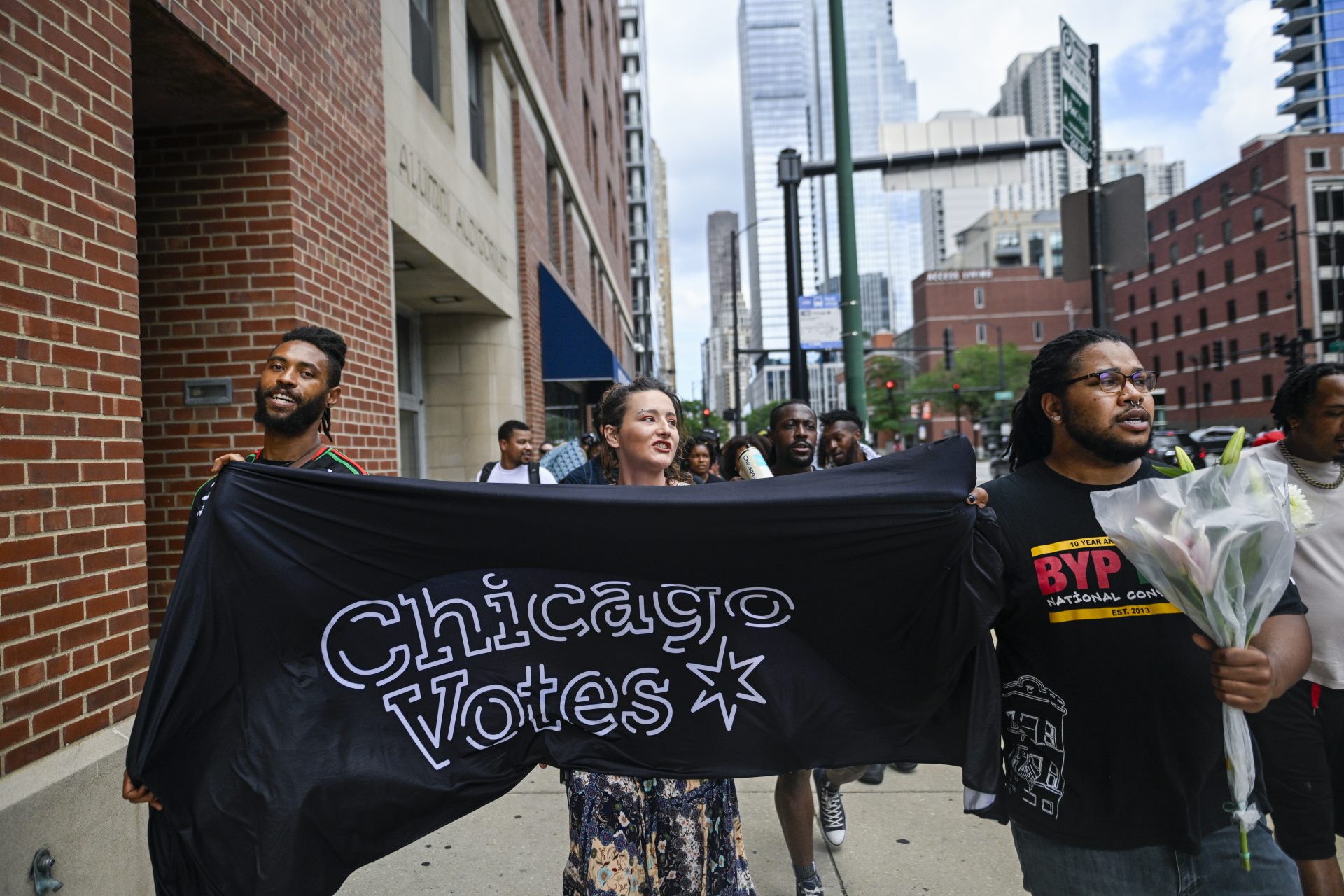
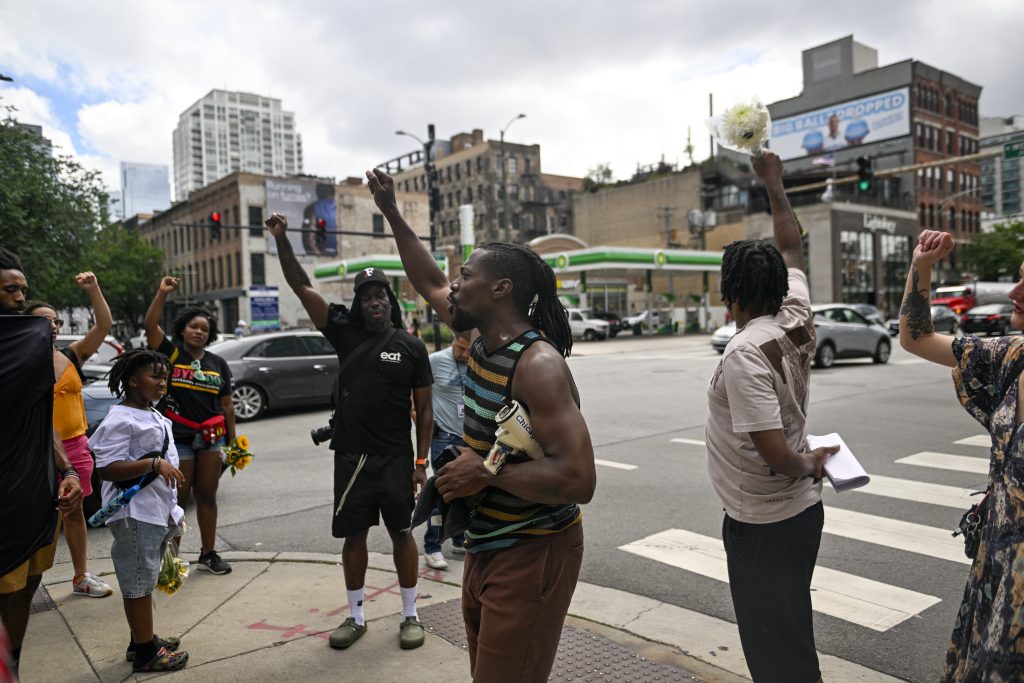
“I love Black people. You don’t love Black people? What’s wrong with you?” was the chant that Liberation House founder and executive director Jonathan Lykes led a group of marchers through at Sunday’s peace walk in the River North neighborhood.
Organized by Chicago Votes, the peace walk served as a moment to reflect on the fatal shootings that took place hours apart in separate locations across Chicago. The first on July 2 outside of Mello Buckzz’s mixtape release party at Artis Lounge and Restaurant, and another in Altgeld Garden early morning on July 3.
Lykes, who’s also a founding member of the Black Youth Project 100 (BYP100), led the peace walk out of Washington Square Park through the streets of River North before ending back in the park. The neighborhood is predominately white, and this particular chant caught the attention of some white onlookers; some of which looked on in confusion and amazement.
“I just like that people were able to come together, not just in a march against police violence or against the state, but a march for our community, to be in love with our community, to have a dedication to our community and to build our community,” Lykes said, “because at the end of the day, the government is not going to save us. We have to save ourselves.”
The peace walk was initially scheduled for July 4, but it wound up being rescheduled to July 6. With the rescheduling came the addition of more grassroots and music organizations like Babes Only and Classick Studios, which helped spread the word for the event on their socials.
“I hope that we begin to do this in mass, similar to when the state has harmed us, that we respond in mass,” Equity and Transformation (E.A.T) founder Richard Wallace said about his hopes for future gatherings.
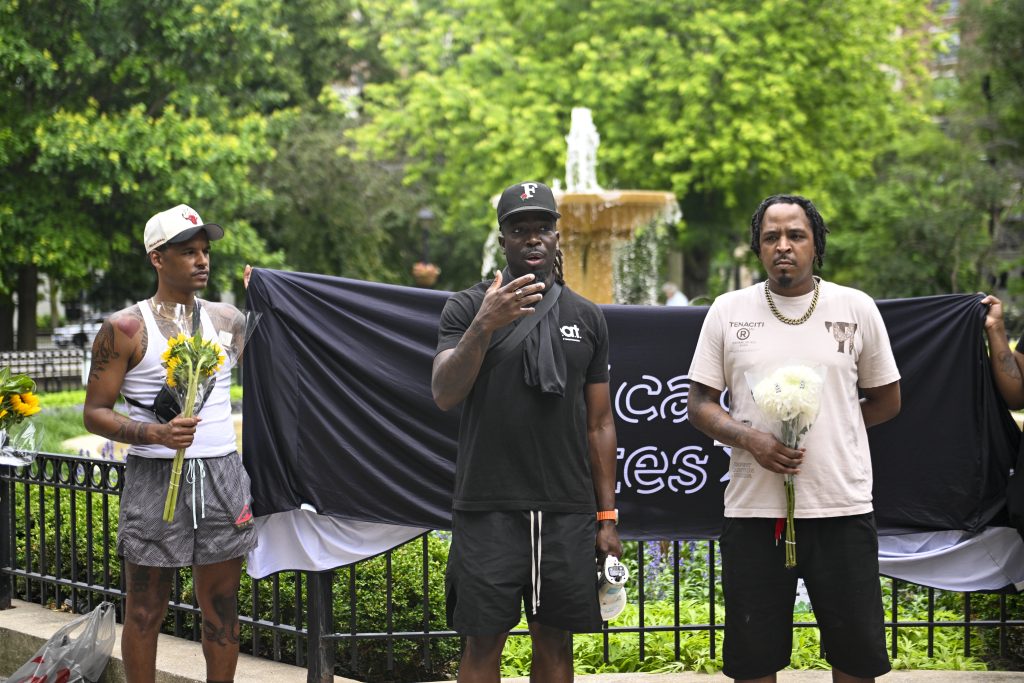
Wallace referred to the violence as a riddle that needs to be solved. “I think the riddle wants us to point the finger at each other, but those that know, know that there’s a system in place that removes 50 schools from the city of Chicago. That knows that the unemployment rate of Black men is damn near 48% right in the state of Illinois,” he said. “Our folks are not prone to the streets, but we’ve been grown in the streets.”
After the shooting outside Mello Buckzz’s party, people took to social media to express their thoughts on drill music. Collectively, the comments became an interesting conversation about whether Chicago should do away with the subgenre altogether or if the issue lies within Chicago’s deeply rooted gang culture.
Local comedian and viral sensation Larry Legend wrote on Twitter that the shooting is one of the reasons why he doesn’t support drill.
“It had its time, we’ve seen the damage and it don’t help nobody but Dwights,” he wrote. “They sold y’all on a dream that this was a way out but nobody escapes a life of revenge. The only people who profit and live a nice life off this shit is people like [music executive] Lyor Cohen. Lil Durk became a superstar and it cost [him] everything. Drill is WACK.”
Formerly known as Chin Chilla Meek, rapper Chimeka also took to social media to express her feelings on the recent events. “The fact that Chicago praises murder music only to turn around and say ‘idk how this happened’ is insane! Y’all asked for this!” Chimeka got her start around 2012, but was tossed into the drill subgenre alongside contemporaries such as Sasha Go Hard, Tink and Dreezy. In a 2018 interview with The TRiiBE, Chimeka said, “Everybody wasn’t drill in Chicago. It wasn’t a sound that represented all of us.”
Rapper Joel Q also joined the conversation online. He expressed his thoughts on the tragedy in some Instagram videos, followed by a post with the words “Drill is dead.”
“I was getting text messages. I was getting DMs, and I’m like, ‘What is going on,’” said Joel Q, who hails from the West Pullman and Roseland neighborhoods.
“I felt obligated to check in and see what was going on, but also use my platform to have a voice, because we also know that unfortunately, the artist who was in that unfortunate event is somebody who creates music that expands the behavior that’s already going on in these unresourced, or disinvested neighborhoods,” he said.
Joel said he took to social media to double down on a post he made earlier in the year. His message at the time also encouraged an end to the drill movement.
“At the end of the day, it’s not a true reflection of who we are as Black people. It’s a reflection of who anybody can be under the right circumstances,” he told The TRiiBE. “That’s what these shorties, for the most part, don’t understand. You all are injecting this in your body. So you live in it. You talking it, you hearing it, like, eventually that’s going to become you.”
Power 92’s DJ Nehpets told The TRiiBE that his fellow DJ friend was at Mello Buckzz’s release party that night. He was relieved when he heard his friend was OK.
“When I saw him, I just told him, ‘man, I’m just so glad you’re here,’ because I’ve dealt with that personally, in my own personal space, of somebody coming to shoot up a spot,” Nehpets said. “It’s so unfortunate, because innocent lives get hit, get killed, all because of a personal situation that’s going on.”
Nehpets added that Power 92 makes a conscious effort to clean up the music it plays as much as possible.
“If we didn’t edit them songs, you wouldn’t hear anything on the radio.” he said.
Drill tracks have often been fueled by conflict. Oftentimes, Nehpets said, he has no clue which songs will cause an issue if played, but he has been approached at parties and asked specifically not to play certain artists due to current beefs and feuds.
Award-winning music journalist Mark Braboy (who has written for The TRiiBE) defends drill music. He said the root issue of violence is not the music; it’s Chicago’s gang culture and the country’s pervasive gun culture. The art is a reflection of people’s lived experiences in underserved and impoverished neighborhoods.
“Chicago has had a long standing issue with gang culture, even before drill music. Chicago has an issue with guns. There are a lot of deep systemic and spiritual issues that have been plaguing Black Chicago and our neighborhoods for a long time,” Braboy said. “Drill music might be a part of that, but to put all that on drill music is complete hogwash.”
Sunday’s peace walk was an example of grassroots organizers and the local music and creative community coming together to mourn the loss of life, strengthen the bonds of community, and search for solutions.
Chicago Votes CEO Stevie Valles addressed the crowd at the end of the peace walk. His speech was hopeful of a future where Black people in the city of Chicago can live and manifest safe spaces to exist.
“This is a beautiful gathering. As Rich said, we typically gather like this in anger. Today, we’re gathering in a similar emotion but it’s to mourn the loss of life,” Valles said. “We ultimately want our society to be a society of living, breathing, free [and] safe Black people. Our lives shouldn’t be taken by anyone: [not] by the system [or] by our own. We deserve better than that.”