




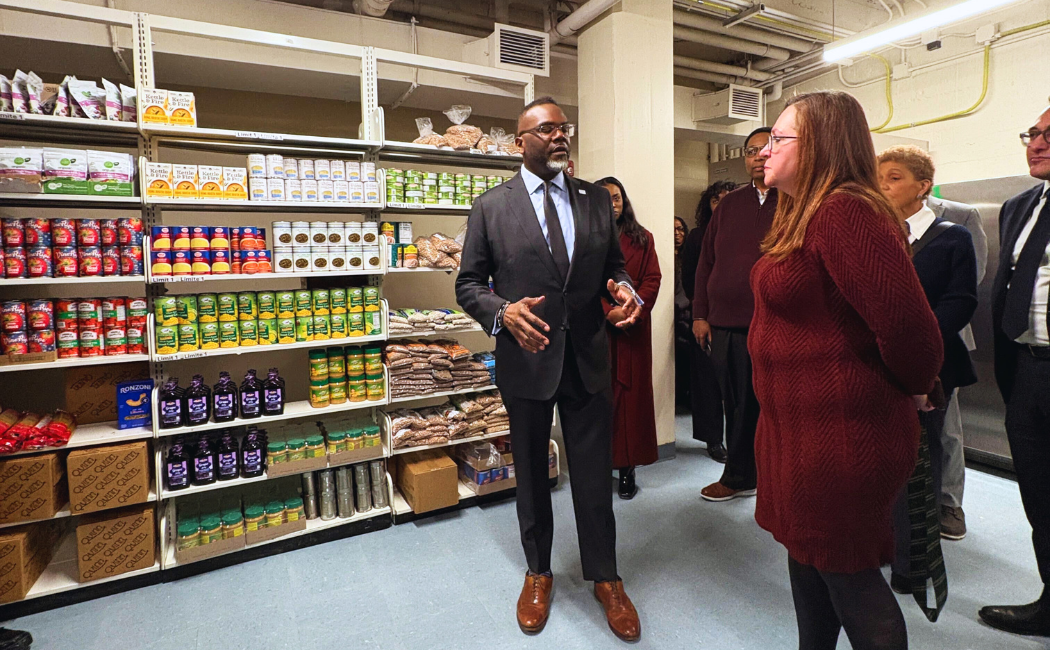
West Garfield Park’s Legler Regional Library is providing meals to those in need through a Library-Based Food Access program, which establishes a food pantry at the West Side library.
The program is a partnership between the Chicago Public Library (CPL) and the Greater Chicago Food Depository. The food pantry soft-launched last July and has served over 700 families since its launch, according CPL officials. It is the second library food pantry in the country and the first for Illinois and Chicago, according to the Greater Chicago Food Depository.
“When these services live together in a trusted space, access becomes easier, and our barriers are removed, which matters so much in a neighborhood and on the West Side, where food services can prove challenging at times,” CPL Commissioner Chris Brown said during the grand opening ceremony “Families can now take care of multiple needs in one visit: learning and food equity.”
The pantry is open on Thursdays from 4:00 p.m. to 7:00 p.m. and Sundays from 1:00 p.m. to 4:00 p.m.
During the grand opening ceremony, officials from the Greater Chicago Food Depository and the city addressed the importance of such programs, noting new work-reporting requirements that will affect SNAP recipients as laws change under the Trump administration. Starting Feb. 1, some people aged 18 to 64 without dependents under 14 will be required to work or volunteer at least 80 hours per month to keep their benefits. This requirement stems from President Donald Trump’s “One Big Beautiful Bill.”
“There are people in our community today who are now losing their food stamps,” Kate Maehr, CEO of the Greater Chicago Food Depository, said. “There is another big cliff where people will begin to go on a time clock that will end on May 1, and we anticipate as many as 120,000 people in Cook County will lose their SNAP benefits.”
This year, some states implemented “SNAP Food Restriction Waivers,” which prevent food stamp recipients from buying certain “non-nutritious items” such as pop and candy. Indiana, Missouri and Iowa are among the states that border Illinois that have the waiver in place.
“This partnership is a clear statement of our commitment to the West Side and to the people who have always made this community strong, even in the face of disinvestment,” Mayor Brandon Johnson said during the ceremony. “Investments like this strengthen neighborhoods, and it helps restore trust in institutions that exist to serve the public good, because we know food access is directly connected to better learning, better health, workforce stability and long term opportunity. It’s why it’s that much more critical that these investments actually manifest.”

The food is provided at no additional cost to the Chicago Public Library, according to Maehr, who added that the program is being supported by philanthropic organizations in Chicago.
Greater Chicago Food Depository officials said the January grand opening, which occurred six months after the launch of the library food pantry, was due to logistical challenges in determining which days work best for community members, as well as the government shutdown.
“In a normal world, that [grand opening] would have taken us to the end of September, and then shut down and the SNAP crisis [happened],” Maehr told The TRiiBE. “That period for the Greater Chicago Food Depository was unlike anything we’ve ever experienced. We cannot do anything but respond to the set crisis at hand andnd so the food continued to flow out.”
While there are no plans to open another library food pantry, CPL Commissioner Brown said they’ll consider expanding this program to other library branches.