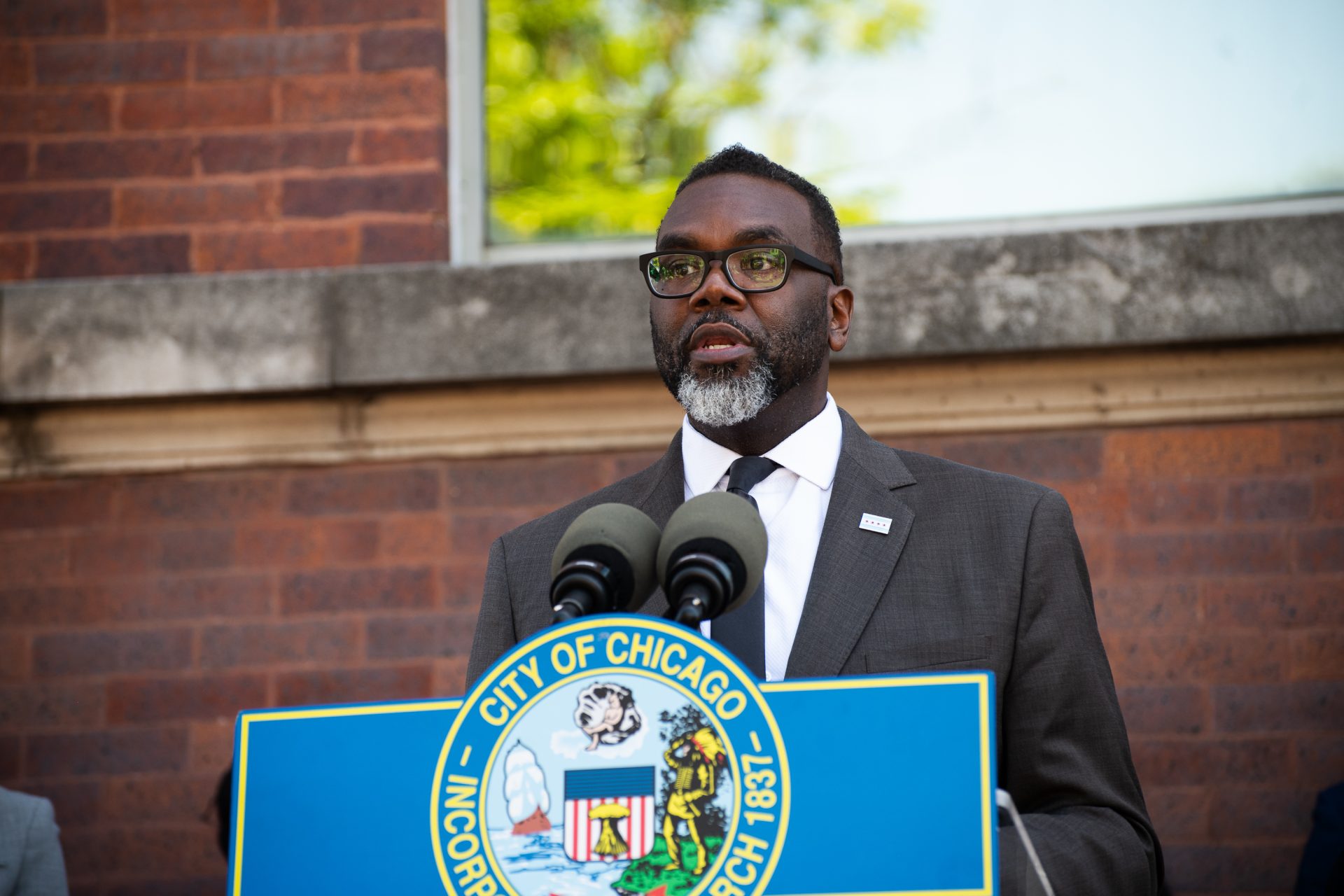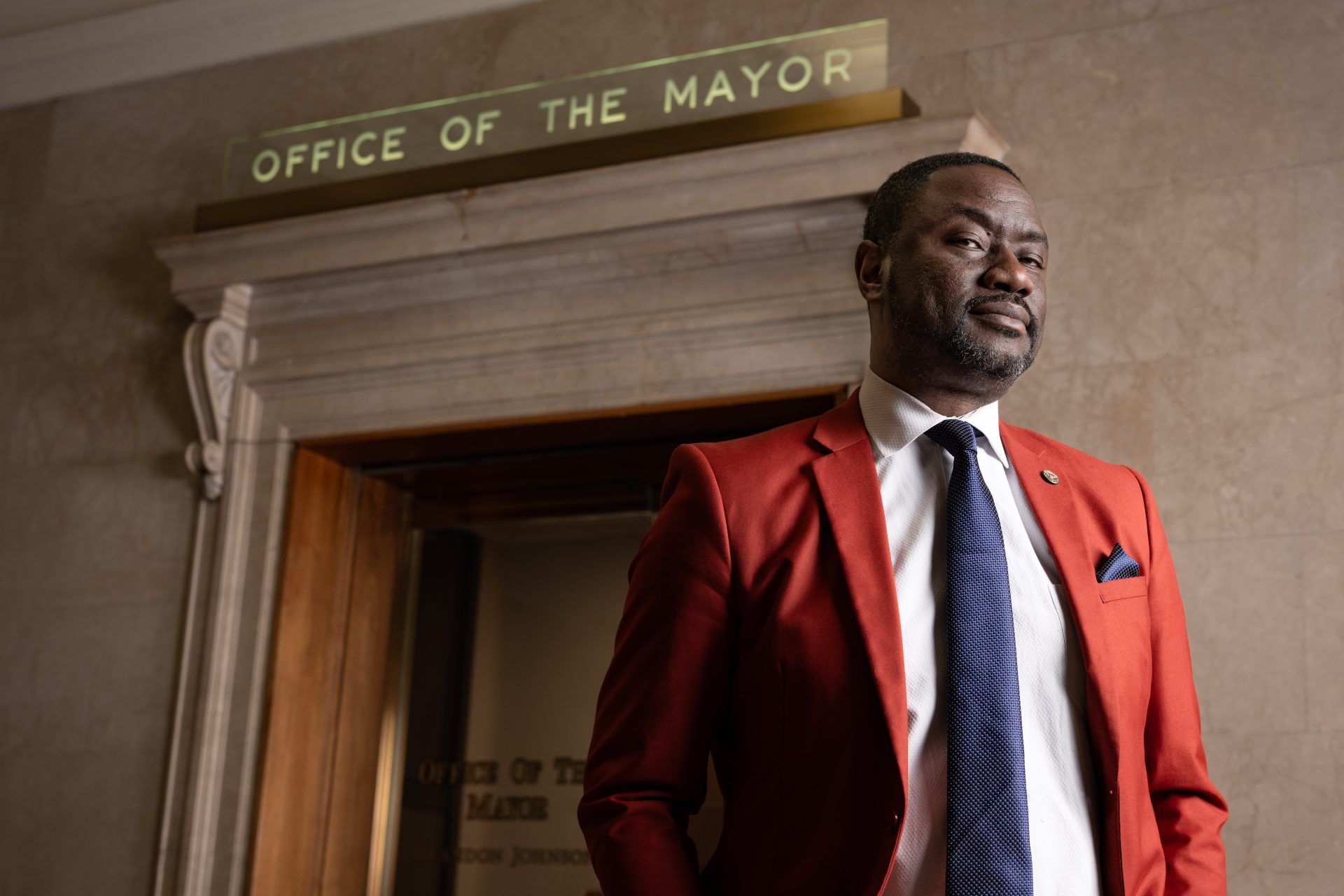


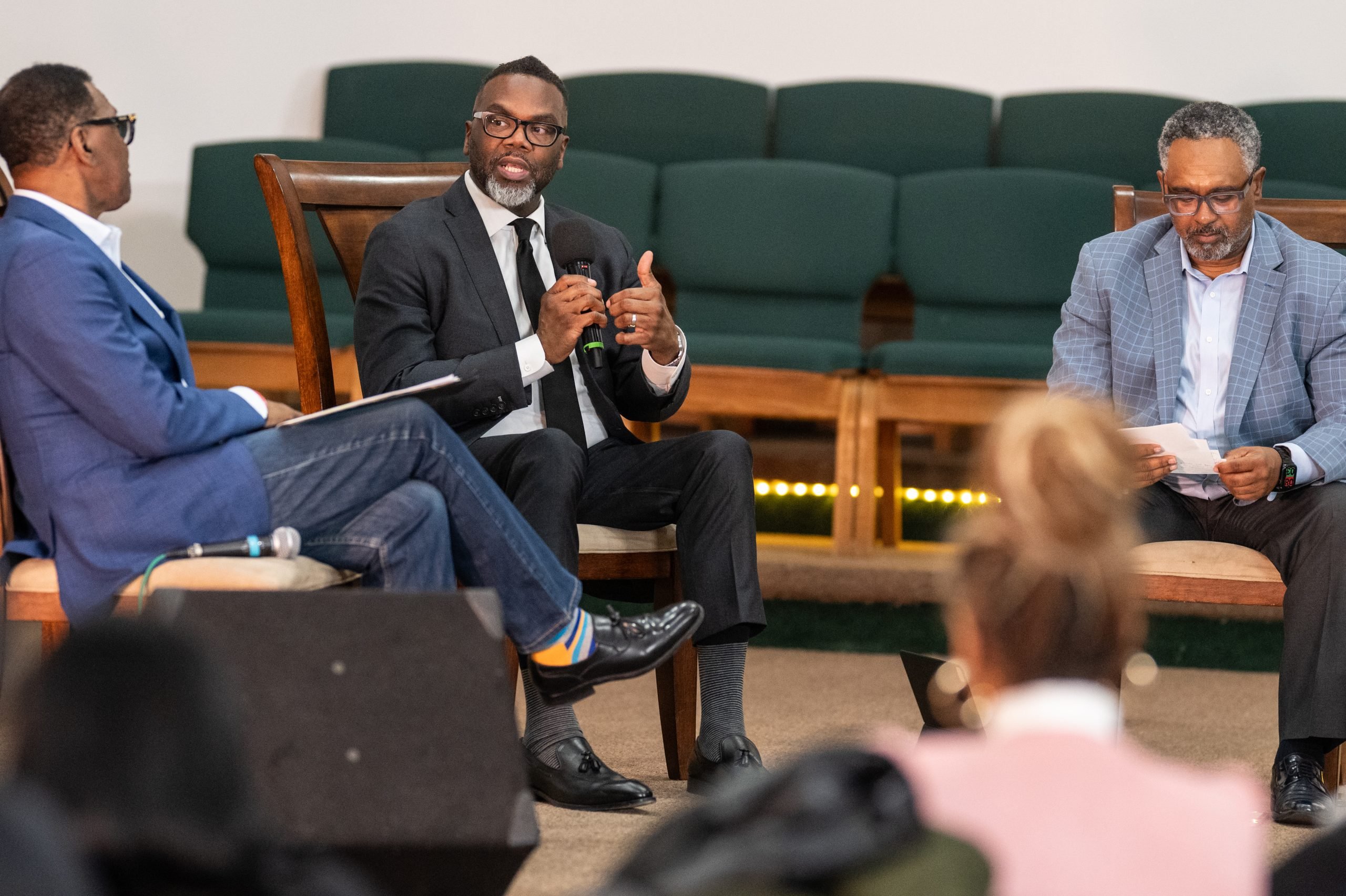
Mayor Brandon Johnson is visiting various neighborhoods for what his administration is calling a “Faith in Government Tour.” The second stop of the public town hall-styled event brought him to East Garfield Park on Chicago’s West Side. There, he spoke about his investments in Black people, and his accountability to the community.
“Over the course of decades, government has consistently let down and disappointed people,” Johnson said. “And so, now I made a commitment to do the opposite, to bring government closer to people.”
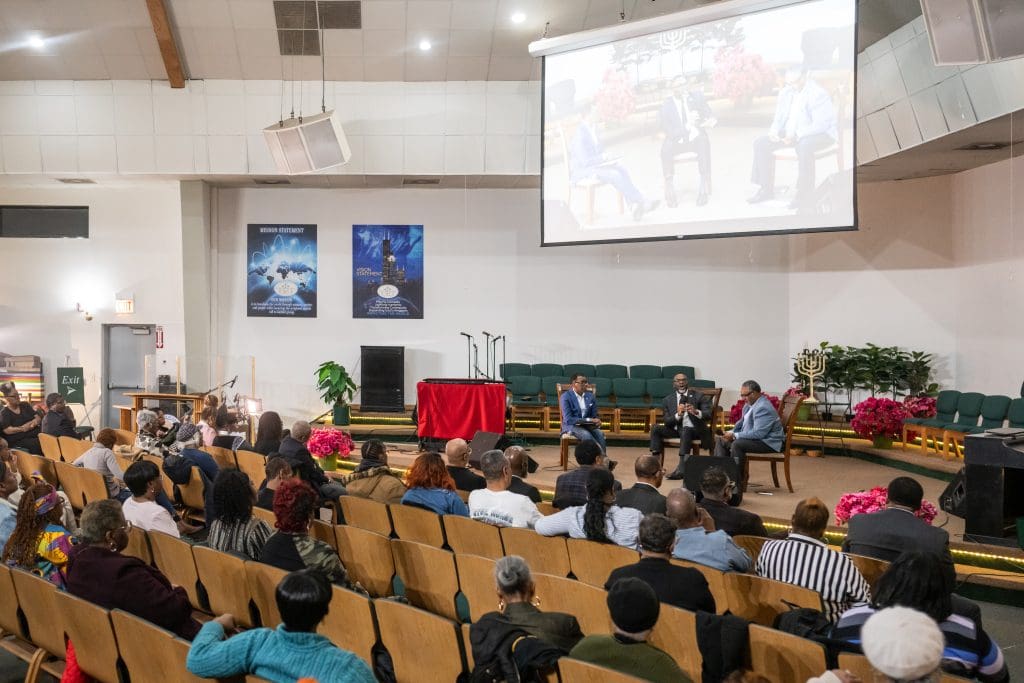
On Wednesday night, the People’s Church of the Harvest on 5th Avenue off Central Park Avenue was half packed with community members who came to join the conversation in the predominantly Black neighborhood, which suffers from historical disinvestment. For the conversation, Johnson answered questions from the audience and spoke with Bishop Dwight Gunn and Pastor Michael Eaddy, who both chair the Westside Community Development Collaboration.
“My analysis is, Chicago has become accustomed to rubber stamp administrations, even when those rubber stamp administrations were undermining the very people that require government to work,” Johnson said to the church. He is referring to the way City Council voted in agreement with past mayors — like the Daleys and Rahm Emanuel — no matter how harmful the deal would be to underserved and over-policed communities, such as the 2019 approval of Emanuel’s $95 million cop academy in West Garfield Park.
“There’s more noise now, because there’s more direction towards our people,” Johnson said.
Homan Square resident Justin Johnson, and his mother Ricneshia Johnson, said they learned about the event from the church, where they are members. Johnson, 21, said he had no expectations coming into the event, but he left feeling like the mayor cares about the Black community.
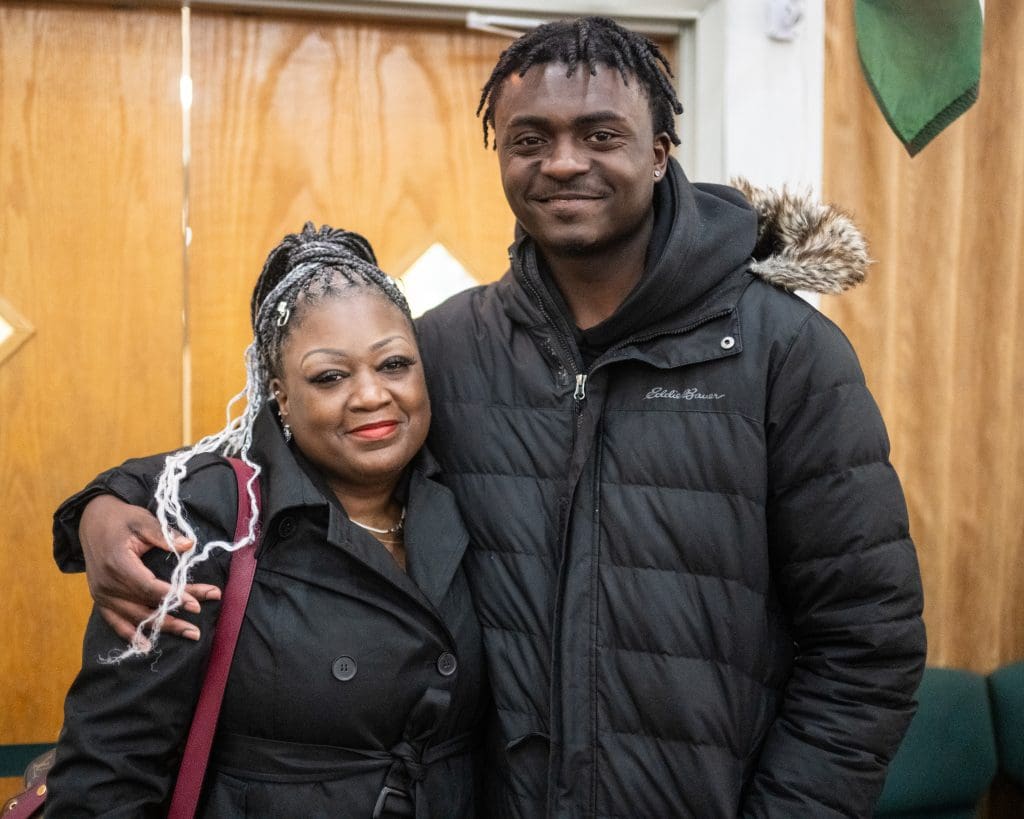
“I wanted to make sure that he cared for us as Black people. With everything that he was saying and the way he introduced himself and connected back to the audience, and all the ways he described money, his family and his upbringing, it made me feel more secure.”
Mayor Johnson doubled down on the $830 million bond deal, stating that it will create jobs while repairing the city’s deteriorating infrastructure. Narrowly passing 26-23 in City Council just hours before the town hall, the plan aims to address infrastructure needs like bridge renovations and repaving roads by borrowing $830 million. Opponents criticized the bond deal as burdening taxpayers in the years to come.
Ald. Walter Burnett (27th Ward), who also serves as vice mayor and was in attendance during the community event, supported the bond deal. While addressing City Council, Burnett said the deal was standard and addresses the city’s infrastructure issues sooner rather than later. Ald. Emma Mitts (37th Ward), who chairs the Committee on Contracting Oversight and Equity, also backed the bond deal and attended the community event.
“I was at a community town hall a few weeks ago and a Black woman said, “Mayor, you gonna fix these streets or fix my car?’ Today we put forth those investments and our streets are going to be paid regardless of who’s in the White House,” Mayor Johnson told the crowd.
Mayor Johnson kicked off the tour on Feb. 10 at New Covenant Baptist Church in the Greater Grand Crossing neighborhood on the South Side. Since then, M3 Strategies and The Urban Center have released a new political poll; results show the mayor having a nearly 80% disapproval rating. Of Chicago’s population of 2.6 million people, 696 people were surveyed for the poll, with 27% of participants identifying as Black and 43% as white. It’s worth noting that Juan Rangel, the CEO of The Urban Center and former head of a Latino charter school organization, has been publicly critical of both Johnson and the Chicago Teachers Union. Crain’s Chicago Business wrote that ex-mayoral candidate Paul Vallas, who was defeated by Johnson in 2023, helped with the Center’s founding.
RoseMarie Rodriguez, an Austin resident, learned about the event through a text message from a friend who attends the church. She said she also went into the event with doubts about investments Johnson was making into Chicago. She said she’s been in many debates with people who feel the mayor isn’t doing anything for them. After the event, she said she felt that Johnson was working “hard to accomplish many of the things that we need accomplished here in Chicago.”
“I felt that he was doing [things], but you got these other cons coming to you saying, ‘Oh no, he’s not doing anything. We got to get rid of him.’ You get confused.” Rodriguez said. “Coming here, listening to him speak, hearing it come out of his mouth, validated that he’s doing what we need done, even though we may not like the process.”
During the event, Mayor Johnson detailed specific developments currently taking place on the West Side such as the $17.5 million expansion of Malcolm X College’s West Campus in Austin. Expansion plans have been in the works since 2017, but were finalized in 2023, after Illinois State Rep. La Shawn Ford secured funding. The remaining funds are coming from City Colleges of Chicago.
He also touched on an upcoming ribbon cutting for the $40 million Grace Manor affordable housing complex in North Lawndale, though funding for the project was secured before he took office.
For the privately-funded $7 billion 1901 Project near the United Center, Johnson hinted at a plan that he and Ald. Burnett (27th Ward) are working on right now; they want the project to include more affordable housing. The project was approved by City Council earlier this month.
Rodriguez said she was pleased to hear of the investments happening in her neighborhood.
“I like hearing what he’s saying, instead of someone else coming [and] telling you what they think he’s saying or what’s written in the [news]papers about what people think that he said [or] their interpretation of it.”
Bronzeville resident Dwayne Lindsey learned about the event through Bishop Dwight Gunn, who heads the church he attends. Lindsey said he has been to other community events with Mayor Johnson and knew what to expect from the conversation, as it relates to solutions and investments he’s made in Chicago. However, Lindsey said he learned about the network of pastors who are doing work to build up the West Side.
“I had heard about the coalition, but I didn’t know it was a coalition of pastors and people on the West Side, or just in the city period, trying to address some of the issues — social issues and just financial issues that people are dealing with in the city,” Lindsey said.
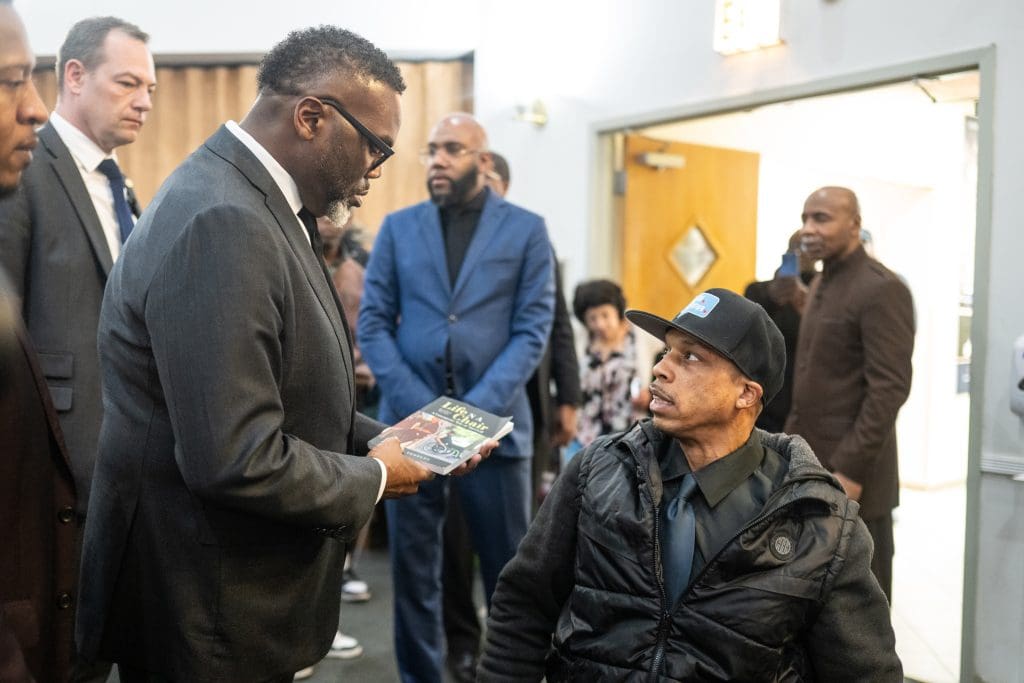
Lindsey said he felt the goal of the event was to inform residents of investments and programs they may not be aware of. Though he couldn’t specifically say whether he feels connected to Johnson’s investments, Lindsey said he connected with the mayor’s morals and viewing everyone like humans, referencing his decision to address migrants sleeping on floors in public spaces.
“I think their race, or what they are, shouldn’t have determined if you’re going to help those people,” Lindsey said about the migrants from Latin America. “I appreciate that, even if other people don’t like it, or take that as that money could have been used somewhere else. It possibly could have, but what would’ve happened to these people? And if we don’t begin to care about people as a whole, this is our problem that we’ve had with people not caring about us.”