

Be Informed, Be Prepared: Subscribe to The TRiiBE’s free weekly newsletter for trustworthy DNC and election news and analysis.
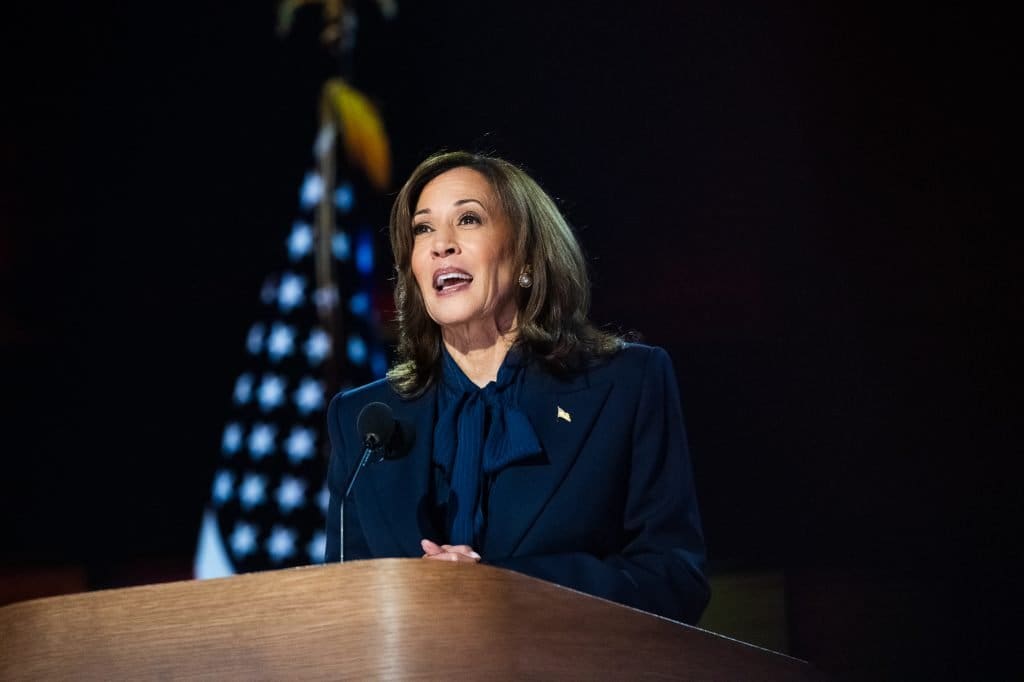
The final night of the Democratic Convention was historic as Vice President Kamala Harris officially accepted the Democratic Party’s nomination for U.S. president, becoming the first Black woman and first person of South Asian descent to lead the Democratic ticket.
The energy in the room was electric. The crowd stood and cheered for three minutes before Harris began speaking. She highlighted key moments in her life that led her to this moment and reaffirmed her commitment to voting rights, abortion rights and LGBTQ+ rights.
“In this election, many other fundamental freedoms are at stake. The freedom to live safe from gun violence—in our schools, communities, and places of worship,” Harris said.
Echoing themes of freedom, unity and compassion, she aligned her message with those shared by the Obamas earlier in the week. She also pledged to sign a bill restoring reproductive rights and a bill that modernizes the 1965 Voting Rights Act.
If Congress approves, the act would prohibit states from enacting discriminatory voter policies. In addition, Election Day would become a federal holiday, voter registration would expand to include same-day and automatic registration and require officials to publicly announce changes at least 180 days before an election, just to name a few.
“The freedom to love who you love openly and with pride. The freedom to breathe clean air, drink clean water, and live free from the pollution that fuels the climate crisis. And the freedom that unlocks all the others. The freedom to vote. With this election, we finally have the opportunity to pass the John Lewis Voting Rights Act and the Freedom to Vote Act,” she said.
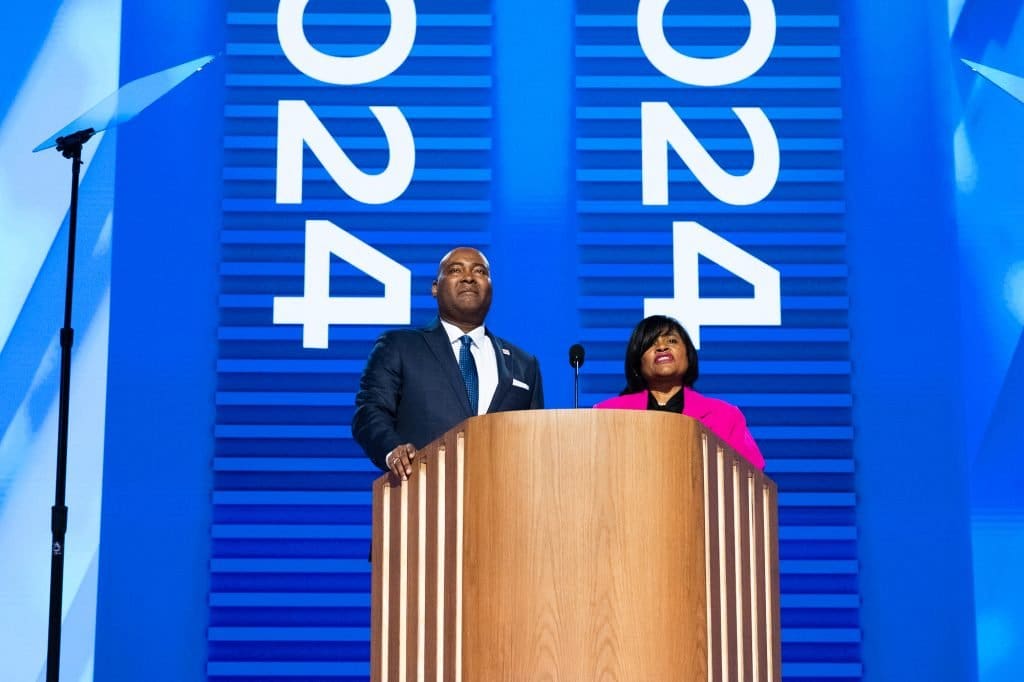
This year’s DNC prominently honored Black political figures who have shaped the Democratic Party. DNC Chairwoman Minyon Moore and Democratic Committee National Chair Jaime Harrison paid homage to political leaders like Lewis, Rev. Dr. Martin Luther King, Jr., Fannie Lou Hamer, Shirley Chisholm, and Rev. Jesse Jackson, acknowledging their contributions to the Civil Rights Movement.
Chicago’s selection as the DNC host city also demonstrates how both Jackson and Chicago have shaped the model for building collective power, according to Illinois State Sen. Robert Peters (D-13).
“This is a unique place where Black political power has grown and flexed. So, having this convention here, having a history that ties to Rev. Jesse Jackson, and having a history that ties to Barack Obama,” Peters said, “we cannot ever lose sight of that. We are an amazing model of what it means to build Black political power, to build Black progressive political power. I’m lucky to be playing my small role.”
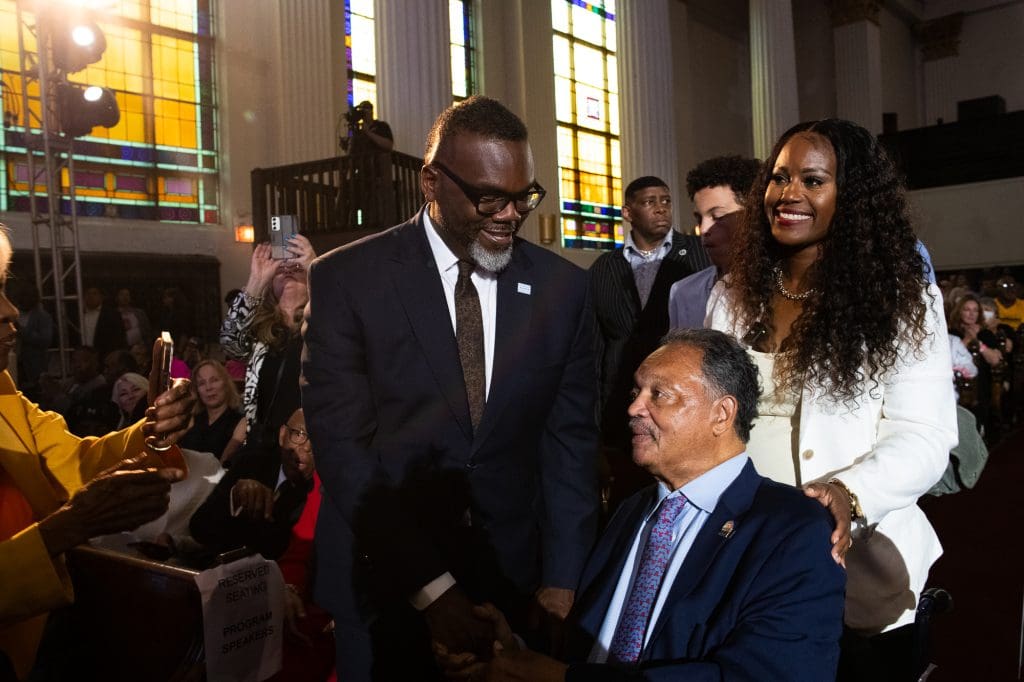
At 82, Jackson, who has been diagnosed Parkinson’s disease, made a surprise visit on Aug. 19, kicking off the DNC’s first night. He received a standing ovation as he waved to the crowd, accompanied by Rev. Al Sharpton, his son, U.S. Rep. Jonathan Jackson, and others.
Jackson’s legacy laid the groundwork for Harris’s historic nomination, just as it did for Barack Obama’s campaign. With Jackson at its helm, Chicago’s Black political movement has been instrumental in shaping these transformative campaigns.
The DNC also marked the 40th anniversary of Jackson’s 1984 speech on the floor of the DNC in 1984 in San Francisco. The previous year, Jackson had announced his intention to seek the Democratic nomination for president.
“Reverend Jackson’s campaigns in both ‘84 and ‘88 really were the lightning rod for so many things,” Rev. Dr. Janette Wilson said. Wilson is a senior advisor to Jackson and an Illinois delegate.
Jackson’s presidential campaigns set the stage for future leaders like Carol Moseley Braun, who in 1992, became the first African American woman in the U.S. Senate because Jackson encouraged her: “if he could run for president, certainly she could run for Senate and win,” Wilson said.
Jackson’s presidential runs, though unsuccessful, propelled him onto the national stage, inspiring a new generation of political leaders, particularly Black political leaders.
His focus on issues affecting Black people and the working class resonated deeply, creating a pathway for candidates like Obama and Harris. Jackson lost the Democratic nomination in 1984 to former Vice President Walter Mondale.
However, his campaign registered over one million new voters, won 3.5 million voters, and helped the Democratic Party regain control of the U.S. Senate in 1986, according to Keeping Hope Alive: Sermons and Speeches of Rev. Jesse L. Jackson Sr.
Jackson ran again to secure the Democratic Party’s nomination in 1988 but didn’t gain enough delegates to clinch the nomination.
“His 1988 campaign registered over two million new voters, won over seven million, and helped boost hundreds of local, country, state and federal elected officials into office,” according to the same text.
Historian Lionel Kimble noted that Jackson’s efforts were crucial in preparing the U.S. for a Black presidential candidate.
“Even though he didn’t win the nominations either of those times, the importance was that he gave a voice to the people who were so far removed from the center of politics that we needed,” Kimble said. He’s an associate professor of history at Chicago State University.
“He had people thinking about poverty and racism on a national scene. It was important for Black folk in particular, but I think all of us in general. If it hadn’t been for Jesse, I don’t know if people would have been ready for an Obama. I don’t think people would have been ready for Harris to run and win,” he said.
Jackson’s influence at the 2024 DNC and on Black political leaders
Jackson’s imprint was evident in some aspects of the 2024 DNC, like his relationships with leaders like DNC chairwoman Minyon Moore, who worked on Jackson’s presidential campaign in 1988 and is also a fellow Chicagoan.
“Working for Reverend Jackson in Chicago instilled in me the values of hard work and service. I’ve carried those lessons with me throughout my entire career and have worked to instill those same values in the next generation of leaders,” Moore wrote in a statement to The TRiiBE. “I’m grateful for the impact he’s had on my life and the impact that I see in so many others.”
Moore was also part of Jackson’s Rainbow/PUSH Coalition, according to Wilson, a senior advisor to Jackson, and an Illinois delegate.
The 2024 DNC’s messages of hope and unity mirrored Jackson’s 1988 DNC speech, where the infamous chant, “Keep hope alive,” emerged. Many convention speakers, like Harris, former President Obama and former First Lady Michelle Obama, evoked similar themes throughout their speeches.
Then, there are the relationships Jackson has built with Black political leaders across multiple generations in Chicago, such as former U.S. Congressman and Black Panther Party leader Bobby Rush, who considers Jackson a mentor and confidant.
“Jesse Jackson saved my life,” Rush told The TRiiBE. “He’s an inspiration. My relationship with Jesse Jackson is far more than politics. He’s prayed for me and been a comfort for me and my family in times of personal tragedy.”
Rush served in the U.S. House of Representatives for 30 years, representing the first Congressional district, once the epicenter of Black political power.
For Black political leaders like Ald. Michelle Harris (8th Ward), Jackson’s lessons on Black empowerment and uplifting Black businesses through the Black Expo were inspiring. The Black Expo was a program started by Jackson to highlight Black businesses. The first Black Expo was held in Chicago in 1967.
His slogan, “I am somebody,” also resonated with her.
Throughout his career, Jackson “opened the door for Black people to be able to do this,” she said, referring to Black people running for political office and winning races.
Jackson’s sphere of influence also includes political strategist Donna Brazile. Brazile also worked on his presidential campaign.
Jesse Jackson and Black political power in Chicago
Jackson was born in Greenville, South Carolina, in 1941. During the 1960s, as a student, he played a role in desegregating a public library in Greenville and leading the sit-in movement. He later moved to Chicago to study at the Chicago Theological Seminary.
Jackson joined the Civil Rights Movement by becoming an organizer with the Southern Christian Leadership Conference (SCLC) in the late 1960s. He was appointed by King to lead Operation Breadbasket in Chicago, a branch of the SCLC that launched in 1966 to improve economic conditions for Black people.
Under Jackson’s direction, the program focused on targeting and boycotting companies that wouldn’t hire Black people. Their boycotts were successful. For example, in the summer of 1966, Operation Breadbasket pushed soft drink bottlers to hire more Black workers, according to Martin Deppe’s book Operation Breadbasket: An Untold Story of Civil Rights in Chicago.
Jackson also hosted weekly radio sessions on WVON that discussed issues plaguing the Black community. Each week, they organized around a call to action to address those injustices, and they typically involved economic injustices, according to Wilson.
For example, the call to action could include marching at construction sites in the city if there weren’t African American contractors working or boycotting stores that sold spoiled food. Their efforts led corporations to sign covenants, where they had to commit to hiring more Black workers, which was empowering for Black people and demonstrated their political power.
Operation Breadbasket later evolved into the People United to Serve Humanity (Operation PUSH) and eventually the Rainbow PUSH Coalition in 1996, continuing its focus on economic justice and political advocacy.
In Chicago, Jackson’s political influence was and still is crucial for candidates with political aspirations. The Rainbow PUSH Coalition radio program and breakfast would be the endorsement of political candidates for successful campaigns.
Political leaders like Obama, late Mayor Harold Washington, former Mayor Lori Lightfoot and Mayor Brandon Johnson, and even Gov. JB Pritzker, have attended the organization’s annual Martin Luther King, Jr. scholarship breakfast.
“Everyone knows that if I’m going to do something in Chicago, I got to go to a Rainbow PUSH event,” Kimble said. “I have to, because that’s where power brokers are going to be. That’s where political opposition is going to be, and this is where the old Black grandmas and grandpas who go to the polls consistently will be.”
Jackson’s influence knows no bounds
Jackson’s influence extended beyond Chicago, especially in mobilizing voters in Illinois and across the South, according to Wilson.
In 1983, “he traveled throughout Mississippi and 11 southern states with the then U.S. Attorney General William Bradford Reynolds, exposing the problems with voting, the barriers to voting, the structural barriers that had to be changed,” Wilson said.
As a result, Black people in those states ran for public offices like county sheriff, county supervisor, state representative and Congress. Jackson’s presence empowered Black people to run for positions of power, further expanding Black political power.
Jackson’s influence on the Democratic Party extended beyond voter mobilization and civil rights activism. One of Jackson’s most important contributions to the Democratic Party was changing how delegates are counted. After the 1984 election, Jackson was credited with advocating for moving away from the winner-takes-all approach. This change was crucial in helping Barack Obama secure enough delegates to win the Democratic Party nomination in 2008.
“He forced the Democratic Party to change the rules because the Democratic party rules were that whoever won the majority of the votes would get all of them [delegates], which is unfair,” Wilson said.
This year’s convention atmosphere felt reminiscent of an ’08 campaign rally for Obama. The transition from President Biden to VP Harris has reenergized the Democratic Party. Obama’s first campaign notably emphasized themes like of hope and unity, and his efforts to build a multiracial coalition and raise funds closely mirror Jackson’s earlier campaigns.
“Vice President Harris is playing out of the Barack Obama playbook, and Barack Obama played directly out of the Jesse Jackson playbook,” Kimble said. He’s specifically referring to how each campaign centers its message on building a multiracial coalition.
Harris securing the Democratic party nomination is a full-circle moment for Black political power in Chicago.
“Chicago is again demonstrating and showing itself as the center of Black politics. It’s very appropriate that we’re nominating this Black woman in the city where a Black man made a very important and historic run for the White House,” Kimble said.